Case 1.1: The Silicon Shield
The Challenge: Defend against a £100M “Unlawful Means Conspiracy” claim in a high-tech software emulation scenario.
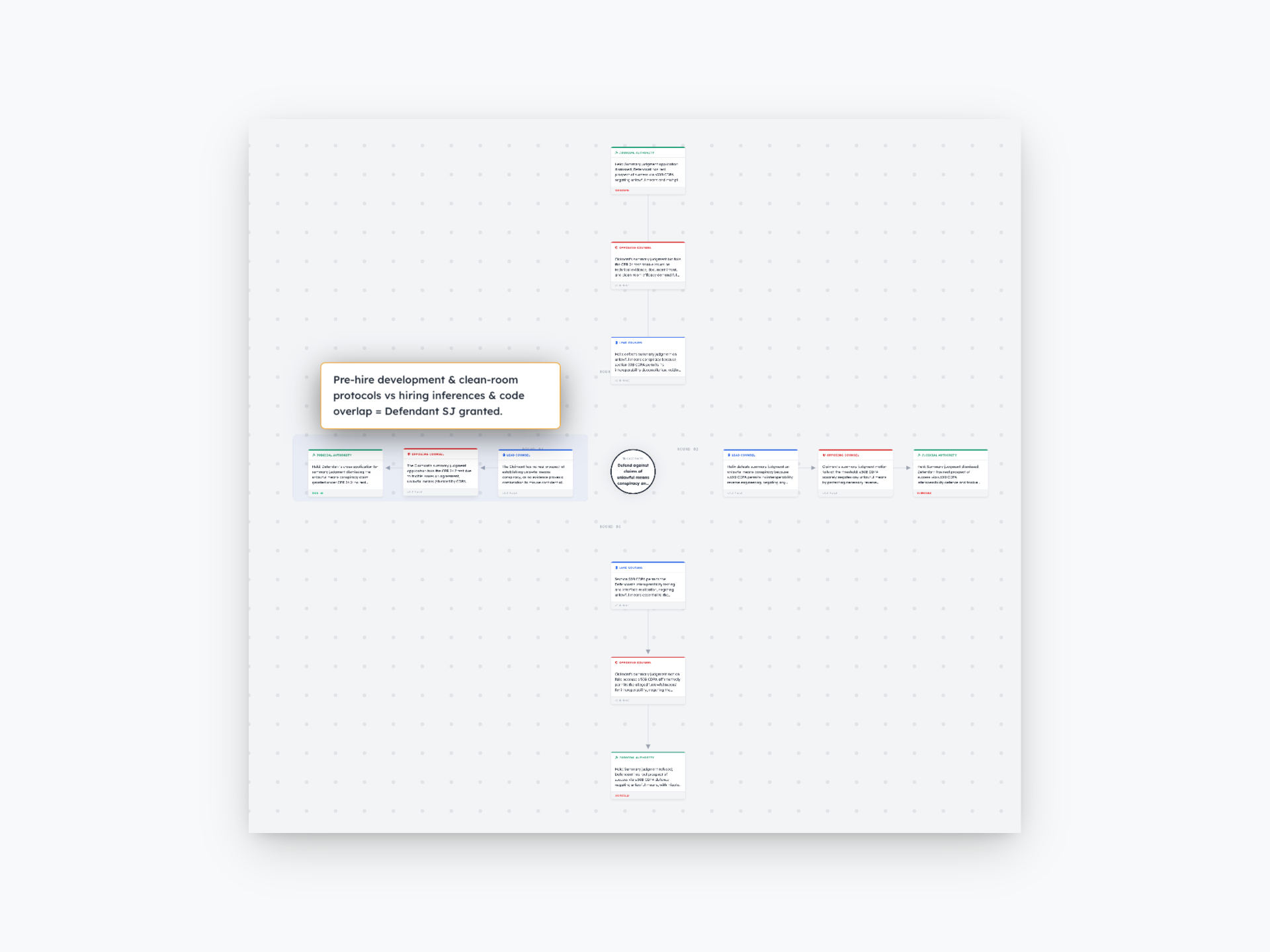
Input Transparency
What We Gave the System
- Case facts: ~50-page document describing facts, allegations, documentary evidence (emails, code repositories, employee records)
- Legal objective: “Achieve summary judgment dismissal of conspiracy claim”
- Jurisdiction: High Court of England and Wales, Chancery Division
What the System Received
- Case corpus: Dense summarization preserving all factual details (hiring timeline, technical similarities, clean-room protocols, Git logs showing independent development)
- Agent instructions: Standard Lead Counsel, Opposing Counsel, Judicial Authority protocols
- No pre-guidance on what laws or procedures to use
Demonstrates: The system was not “steered” toward the statutory preemption theory; it discovered this pathway autonomously.
The Problem Structure
A classic game-theoretic information asymmetry where the opponent held “hot documents” suggesting conspiracy between the hiring of ex-employees and the technical similarity of the systems.
The Strategic Journey (Rounds 1-4)
Round 1: The Obvious Defense
- Lead Counsel proposes standard copyright defenses (clean-room protocols, independent development evidence).
- Opposing Counsel highlights employee hiring timeline and undeniable code similarities despite “clean room” claims.
- Judicial Authority: Conditional. “Code similarity + employee hiring is suspicious; need stronger response to conspiracy element.”
Round 2: The Factual Deepening
- Lead Counsel shifts to temporal evidence (Git logs proving independent code commits before the “suspect” employee hiring; Jira records showing design decisions predating the supposed knowledge transfer).
- Opposing Counsel: “Employees could have reverse-engineered or provided oral guidance without leaving Git traces.”
- Judicial Authority: Conditional. “Temporal evidence helps but doesn’t eliminate conspiracy inference; need legal doctrine that precludes conspiracy liability.”
Round 3: The Pivot
- Lead Counsel identifies that Section 50B CDPA grants a statutory right to create derivative works from lawful software access. If Section 50B permits the conduct, does the conspiracy tort still apply?
- Opposing Counsel: “Section 50B is a defense to copyright infringement, not to conspiracy.”
- Judicial Authority: Receptive. “Interesting—if statute permits conduct, does tort liability follow from same conduct? This needs development.”
Round 4: The Breakthrough
- Lead Counsel argues that Statutory Pre-emption doctrine means Section 50B retroactively eliminates the “unlawful means” element of conspiracy. “Once statutory rights permit access and reverse engineering, the underlying conduct cannot be ‘unlawful means’ for conspiracy purposes.”
- Opposing Counsel unable to formulate credible counter; judges cannot criminalize conduct that the legislature has expressly permitted.
- Judicial Authority: Win. Conspiracy claim dismissed on pleadings via statutory pre-emption.
The Breakthrough Insight: Statutory Pre-emption didn’t just defend the copyright claim—it retroactively annihilated the tort of conspiracy by removing the “unlawful means” element. This is a “Move 37” example: winning through logical annihilation rather than rebuttal.
The Procedural Victory
The system successfully moved for summary judgment on the conspiracy claim (moving from defense to offense), using temporal evidence (Git logs) to sever the causal link required for conspiracy.
Why This Matters
Demonstrates Lawgame’s ability to synthesize technical evidence (Git logs, clean-room protocols) with black-letter statutory law to find a “kill shot” that most human lawyers would have missed because it requires holding multiple complex doctrines in mind simultaneously.
Innovation Lab Highlight
“The Logical Annihilator” strategy—showing how statutory rights can be used to delete a tort’s foundational element entirely.