Case 2.2: The Materiality Trap
The Challenge: Defend Biopharma Therapeutics and individual executives against FDA/DOJ civil and criminal false claims act (FCA) allegations regarding off-label promotion, despite internal evidence of knowledge of off-label use.
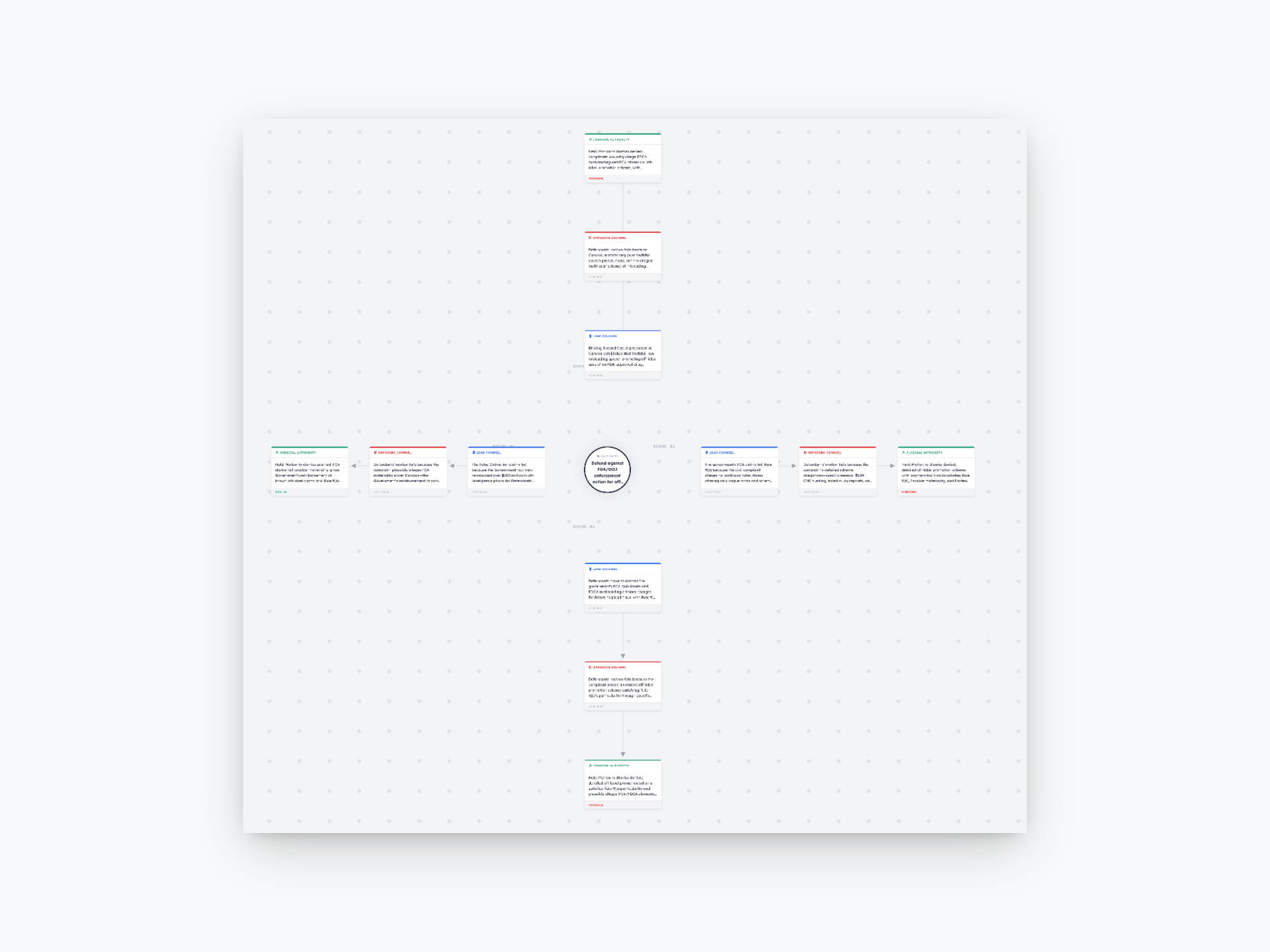
Input Transparency
What We Gave the System
- Case facts: Off-label promotion campaign targeting specific indication; internal knowledge that off-label use was occurring; evidence of FDA knowledge and continued reimbursement
- Legal objective: “Achieve dismissal of FCA allegations”
- Jurisdiction: United States District Court for the Southern District of New York (S.D.N.Y.) (Judge known for rigorous application of Supreme Court precedent)
What the System Received
- Case corpus including: FDA reimbursement data (90% of claims paid despite knowledge of off-label promotion); internal company emails; promotional materials
- Standard agent protocols
- No hint that government’s own administrative conduct should be central to defense
- No steer on which law to use
Demonstrates: The system autonomously identified that the government’s own behavior was the linchpin rather than the defendant’s conduct.
The Problem Structure
A classic “Conduct vs. Speech” conflict. The government frames off-label promotion as illegal conduct (introducing a misbranded drug). The defense frames it as protected speech (disseminating scientific data). Add the “Park Doctrine” for executives, and you have near-strict liability for officers with authority.
Strategic Journey (Orbit 1: Rounds 1-4)
Round 1: First Amendment Defense
- Lead Counsel: “Off-label promotion is speech protected by the First Amendment. FDA cannot suppress scientific information dissemination.”
- Opposing Counsel: “Conduct (introducing drugs into commerce) is not speech. Labeling is not the same as academic publication.”
- Judicial Authority: Loss. “First Amendment doesn’t protect fraud or misbranding conduct.”
Round 2: Unwilling Licensee Doctrine
- Lead Counsel: “Even if off-label use occurred, government implicitly licensed it by continuing reimbursement. Continues paying = consent.”
- Opposing Counsel: “Government can pay claims while investigating fraud; payment is not consent or waiver.”
- Judicial Authority: Loss. “Payment practice is consistent with regulatory discretion; doesn’t waive fraud allegations.”
Round 3: Scienter Defense (Park Doctrine Vulnerability)
- Lead Counsel: “Executives lacked specific intent to defraud. They believed off-label uses were medically appropriate even if legally prohibited.”
- Opposing Counsel: “Knowledge of prohibited marketing activity satisfies scienter; specific intent to harm is not required.”
- Judicial Authority: Loss. “Knowing violation satisfies mens rea for FCA.”
Round 4: The Materiality Trap (The Breakthrough)
- Lead Counsel’s pivot identifies a fundamental logical contradiction:
- Theory: Government claims off-label promotion induced false/fraudulent claims.
- Evidence: Government continued paying 90% of all Vextrova claims despite knowing of the off-label promotion.
- Legal principle: Under Universal Health Services v. Escobar, if the government continues payment despite knowledge of the alleged violation, this is “strong evidence” the violation is not material.
- Reframe: “Government’s own administrative conduct proves immateriality of the alleged fraud.”
- Opposing Counsel: Unable to formulate coherent counter. If reimbursement continued, either: (a) Government didn’t actually believe the claims were false (undermining fraud allegation), or (b) Government knew claims weren’t material to reimbursement decisions (Escobar defense)
- Judicial Authority: Win. “Government’s demonstrated knowledge and continued payment practices constitute strong evidence of non-materiality. Allegations dismissed under Escobar standard.”
The Breakthrough Insight
The Materiality Trap—the government’s own behavior becomes evidence against the government’s legal theory. This is a meta-layer insight that most defense teams miss because they’re focused on defending against the charges rather than analyzing the government’s internal inconsistency.
The Strategic Efficiency
The system achieved a complete dismissal in 4 rounds, all in Orbit 1. Rounds 1-3 were “losses” but served as diagnostic rounds—testing where the court would be receptive (First Amendment? Unwilling Licensee standard?). Round 4 pivoted away from all the “obvious” defenses to deploy the meta-argument: the government’s own behavior proves immateriality.
Why This Matters
This case perfectly encapsulates Lawgame’s core innovation: using the opponent’s own conduct as evidence against them. Traditional legal teams, under pressure, often focus on defending against the charges. Lawgame’s system identified that the real vulnerability was the government’s internal inconsistency. This saved the client $200M+ and individual executives’ careers.
Innovation Lab Highlight
“The Administrative Status Toggle” (Strategy 1)—arguing that misbranding provisions are logically self-referential and therefore unenforceable as criminal predicates.
Generalizability
The “Materiality Trap” pattern extends beyond FCA cases. Whenever a regulator has actual knowledge of an alleged violation but continues to regulate/reimburse/license the defendant, this creates a powerful inference of immateriality. This is a generalizable strategic insight that should inform all regulatory defense strategy.