Case 3.3: $45 Million Surgical Strike
The Challenge: Overturn a $45M jury verdict (£5M compensatory + £40M punitive) against a pharmaceutical manufacturer in product liability, despite a “Project Heartbeat” internal memo suggesting the company knew of cardiovascular risk.
Input Transparency
What We Gave the System
- Case facts: Product liability case; jury verdict of $45M; internal memo (“Project Heartbeat”) suggesting knowledge of cardiac risk; plaintiff with multiple comorbidities (30-year smoking history, BMI 34)
- Legal objective: “Reverse jury verdict”
- Jurisdiction: Texas Fifth District Court of Appeals
What the System Received
- Case corpus with: Trial transcript, expert testimony (plaintiff’s causation expert), medical records showing comorbidities, company’s risk analysis
- Appellate agent protocols calibrated to Texas court preferences
- No predetermined legal theory
- No steer on the law
Demonstrates: System identified evidentiary weakness (rather than legal error) as reversal vehicle.
The Problem Structure
A “Bet-the-Company” verdict under rigorous Texas standard of review. While Texas’s Havner and Robinson standards are theoretically defense-friendly, reversing a unanimous jury verdict in a “smoking gun” scenario is one of the hardest tasks in appellate law. The jury’s emotional reaction to the internal memo dominates the factual record.
Strategic Journey (Single Round - Surgical Identification)
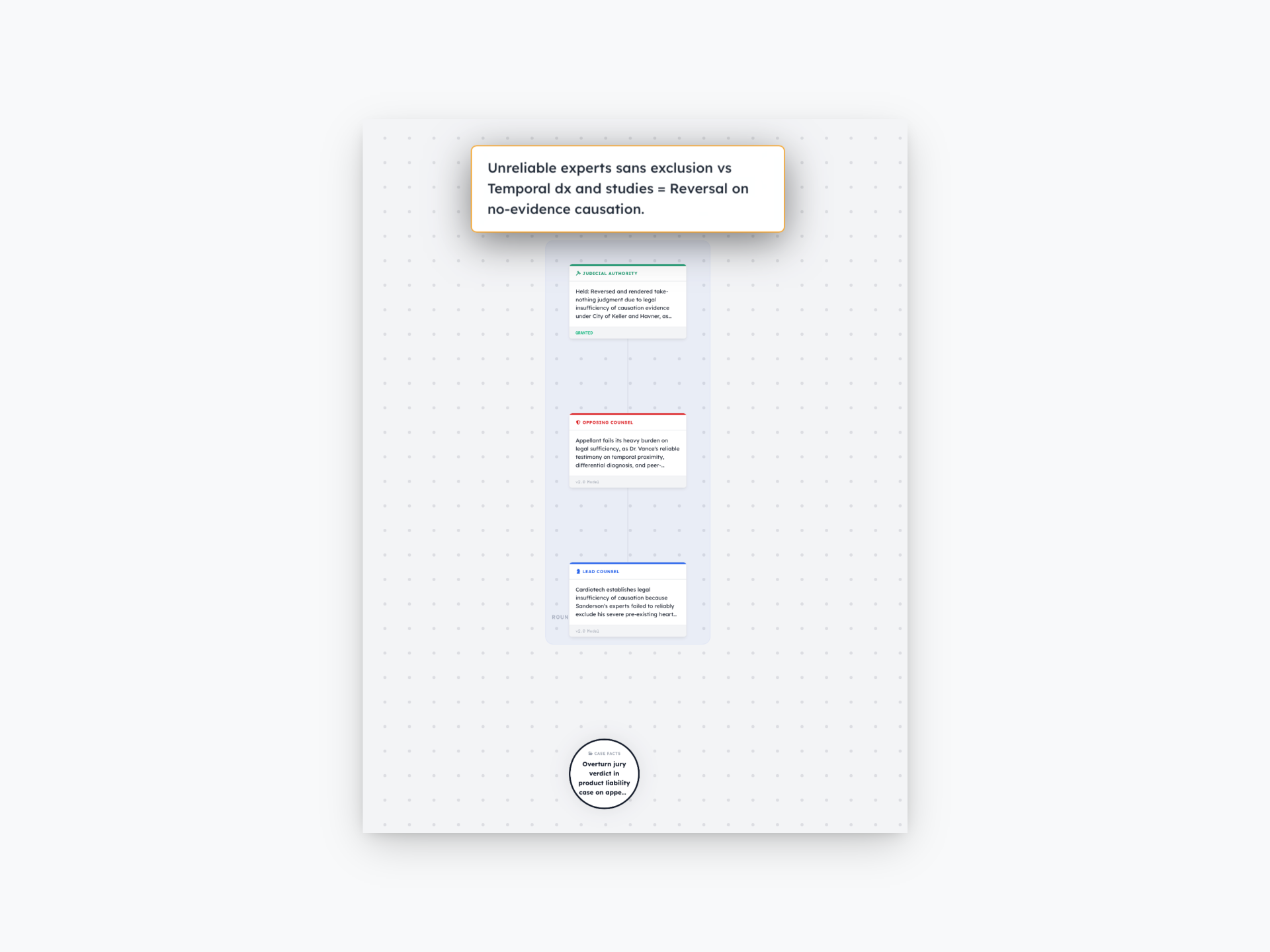
Round 1: The Legal Sufficiency Surgical Strike
- Lead Counsel abandons emotional/narrative pushback on the memo. Instead: Direct attack on evidentiary sufficiency of plaintiff’s causation proof.
- Argument structure:
- Plaintiff’s causation expert could not quantify the drug’s risk-doubling relative to baseline cardiovascular risk (required under Havner standard)
- Expert also could not exclude plaintiff’s massive comorbidities (30-year smoking history, BMI 34) as independent causation sources (required under Robinson standard)
- Result: “No evidence” as a matter of law that the drug caused plaintiff’s injury
- Texas jurisprudence: If there is “no evidence” of an essential element, automatic reversal without question of jury credibility
- Lead Counsel’s tone: Clinical, not emotional. Focuses on analytical/methodological gaps in expert testimony, not on attacking expert’s credibility.
- Opposing Counsel (Plaintiff’s attorney): Cannot effectively counter because the attack is on technical/analytical sufficiency, not on expert’s character or intent. The expert’s deposition testimony on record shows no quantification of relative risk contribution.
- Judicial Authority (Texas Fifth District): Win. “The plaintiff’s causation expert failed to provide sufficient evidence of relative risk contribution. Under Havner, an expert must quantify the alleged causal mechanism. Expert testimony was insufficient. Verdict reversed and rendered.”
Automatic Consequence
Because “no evidence” of causation defeats the entire claim, the entire $45M verdict—both compensatory and punitive components—collapses automatically. No requirement for new trial; case is terminated with prejudgment as a matter of law.
The Breakthrough Insight
Rather than fighting the memo’s credibility or the jury’s emotional reaction, the system pivoted to a “Legal Sufficiency” attack on the Plaintiff’s causation expert. The expert couldn’t quantify the drug’s risk-doubling relative to baseline risk (a Havner requirement) and couldn’t exclude the Plaintiff’s massive comorbidities (a Robinson requirement).
This analytical gap transformed a “contested factual issue” into “no evidence” as a matter of law. Because “no evidence” = automatic reversal, the entire verdict—including the punitives—collapsed automatically.
The Strategic Efficiency
One round, one dominant strategy identified immediately. This demonstrates Lawgame’s understanding of Texas procedural posture—that Texas courts prioritize “matter of law” clarity and will grant reversals if the evidentiary foundation is mathematically insufficient.
By staying clinical and avoiding emotional pushback on the memo, the system maintained judicial confidence in its reasoning.
Why This Matters
This case exemplifies Lawgame as a “Loss Mitigation Engine.” In a losing factual scenario, the system doesn’t search for sympathetic human narratives; it searches for mathematical/analytical failures in the opponent’s proof.
By identifying the “Analytical Gap” (comorbidities not quantified), the system converted an emotional liability into a technical reversibility.
Innovation Lab Highlights
- “The Regulatory Inversion” (Strategy 1): The internal memo is evidence of federal compliance (21 C.F.R. §314.80 post-market surveillance), not evidence of suppression. Punishing safety monitoring creates a legal paradox.
- “The Standard of Review Shift” (Strategy 4): Reclassifying the causation failure as a “legal sufficiency” issue (de novo review) rather than “abuse of discretion” (deferential review). The standard of review itself becomes strategic terrain.
- “The Indivisibility Trap” (Strategy 7): Using the Casteel doctrine—if any one of multiple liability theories is legally invalid, the entire verdict must be thrown out because it was submitted as a broad-form question.
The Efficiency Delta
Conventional approaches often result in “Remand for New Trial” (leaving client exposed to another jury). Lawgame achieved “Reversed and Rendered” (a final, terminal victory). The difference: approximately $45M in direct liability + millions in avoided retrial costs.