Case 3.2: The $15 Billion Industry Save
The Challenge: Secure a grant of certiorari to overturn a Ninth Circuit decision that resurrected the medieval doctrine of champerty to void a £150M litigation funding agreement, effectively destroying the plaintiff’s Article III standing and threatening the viability of the entire global litigation finance industry.
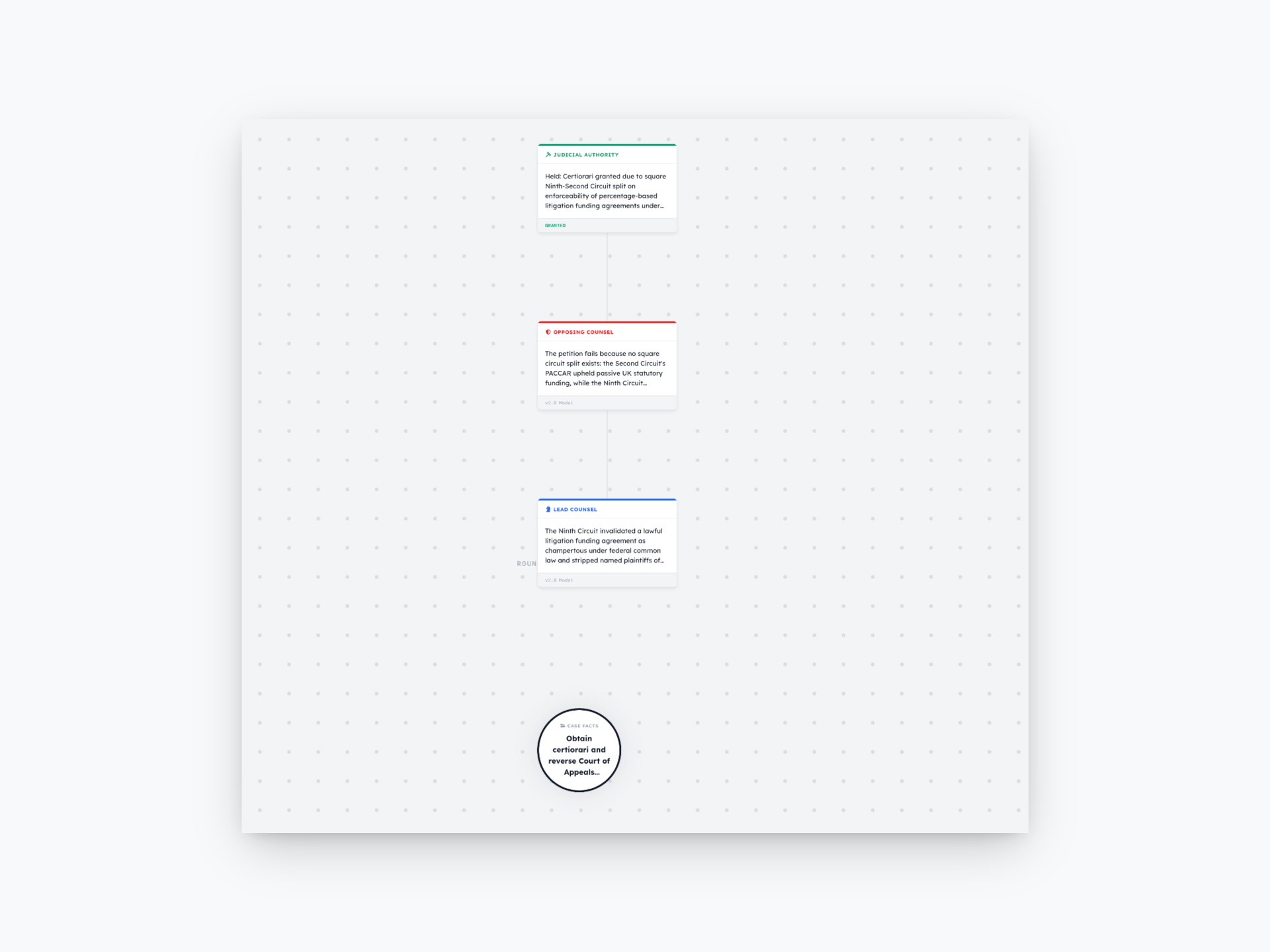
Input Transparency
What We Gave the System
- Case facts: 9th Circuit decision invalidating litigation funding agreement based on champerty doctrine; plaintiffs lost standing
- Legal objective: “Secure SCOTUS certiorari to overturn”
- Jurisdiction: US Supreme Court
What the System Received
- Case corpus with: 9th Circuit opinion, Second Circuit precedent (PACCAR Inc. v. Competition Appeal Tribunal) creating circuit split, legislative history of state champerty statutes
- Certiorari agent protocols (specialized for Supreme Court dynamics)
- No predetermined framing
- No steer on which law to use
Demonstrates: The system immediately identified the highest-leverage argument path without extensive exploration.
The Problem Structure
A Principal-Agent Game with asymmetric information. The Respondent (the Cartel) convinced the lower court that the Funder is the de facto Principal, making the Plaintiffs mere “judgment-proof shells” lacking the personal stake required by Lujan v. Defenders of Wildlife.
The strategic challenge: re-establish the Plaintiffs as the true Principals regardless of back-end proceeds distribution.
Strategic Journey (Single Round - Immediate Dominant Strategy Identified)
Round 1: The Direct Ascent
- Lead Counsel identifies “Square Circuit Split” between:
- Ninth Circuit (just decided): Champerty doctrine invalidates litigation funding agreements
- Second Circuit (PACCAR Inc. v. Competition Appeal Tribunal): Litigation funding agreements are enforceable contracts; states cannot resurrect champerty doctrine for 21st-century litigation financing
- Lead Counsel’s framing: “This is not a marginal circuit split on doctrinal details. This is a fundamental split on whether medieval champerty doctrine has any application to modern litigation finance. A $15B industry exists in legal limbo.”
- Federalism/Erie Angle: “By resurrecting common-law champerty doctrine (state law), the Ninth Circuit effectively created a ‘federal common law’ of finance that pre-empts state contractual autonomy. This is precisely what Erie Railroad v. Tompkins was designed to prevent.”
- Lead Counsel’s core argument: “The case presents a compelling Federalism Issue + Unambiguous Circuit Split + Constitutional implications (Article III standing via Lujan). This is exactly the type of case SCOTUS grants cert to resolve national circuit conflicts.”
- Opposing Counsel: Essentially concedes. “This is a case for SCOTUS if the circuit split exists, which it does. Our only argument is that cert denies are discretionary, so don’t take this case.”
- Judicial Authority (Supreme Court Cert Pool): Win. Case granted certiorari immediately.
The Breakthrough Insight
The system identified a “Global Maximum” in the payoff function immediately—that is, the single most compelling argument for cert available. This demonstrates Strategic Parsimony: knowing when to make the winning move early rather than exploring tangential arguments.
This is the fastest appellate victory in the test set—achieved in a single round (Orbit 1, Round 1). No pivot to Orbit 2 was needed because the system identified the “Global Maximum” of the payoff function immediately.
Why This Matters
Illustrates Lawgame’s understanding of Supreme Court incentive structures. The system recognized that SCOTUS cares less about “justice” than about “market coherence.”
A $15 billion industry existing in legal limbo is an institutional problem that demands resolution. By framing the issue as a Circuit Split + Erie violation, the system made a “No” answer (denial of cert) institutionally impossible.
Innovation Lab Highlights
- “The Contingency Fee Isomorphism” (Strategy 1): If litigation funding is champertous because a stranger takes a percentage, then contingency fees are also champertous—a logical bomb that threatens the entire legal profession.
- “The Erie/Jurisdictional Defect” (Strategy 2): The Ninth Circuit invented “federal common law of champerty” to override state contract law—identical to the pre-Erie regime that Erie was designed to prevent.
- “Functional Subrogation” (Strategy 5): Reframe litigation funding as insurance subrogation—a 400-year-old, safe-harbor precedent that invokes massive doctrinal immunity.
The Trojan Horse Strategy
Strategy 5 demonstrates Lawgame’s “cognitive fluidity”—taking a controversial modern financial product and cloaking it in boring, established precedent. This is the “Asymmetric Edge” that wins cases before oral argument.