STRATEGIC POSITIONING & DEVELOPMENT ROADMAP
7.1 Strategic Quality: Lawgame and Human Counsel
Cost and speed are quantifiable; strategic quality is harder to measure but more important. The comparison is between Lawgame-assisted strategy and unassisted human strategy.
Traditional approaches possess irreplaceable strengths. Experienced lawyers hold institutional knowledge about specific judges, opposing counsel, and courts beyond any dataset. Client relationships inform strategic priorities beyond legal merits. They detect “soft signals” - a judge’s tone at case management, hesitation before questions, patterns in recent speeches - revealing judicial thinking before crystallisation in rulings. They judge non-legal dimensions: reputational consequences, business relationships, regulatory goodwill, board dynamics.
These strengths coexist with structural weaknesses: time constraints limit strategic alternatives explored; emotional investment in initial case theory creates anchoring bias resistant to abandoning costly-developed strategies even when evidence suggests failure; early choices constrain later options with increasing reversal costs; systematic counterfactual exploration proves difficult when already committed to an initial path.
Lawgame’s strengths are precisely complementary. It explores the strategic space exhaustively, testing dozens of approaches against adversarial opposition. Without emotional investment in any theory, it abandons failing strategies without hesitation. It identifies opponent vulnerabilities through systematic analysis rather than intuition, exploring counterfactuals routinely since multi-orbit recursion tests alternative pathways when the primary fails.
Lawgame’s weaknesses are equally clear: it lacks institutional relationships and cannot assess soft signals; cannot judge non-legal dispute dimensions; cannot account for opposing partners’ reputations, recent judicial doctrine signals, or client board preferences.
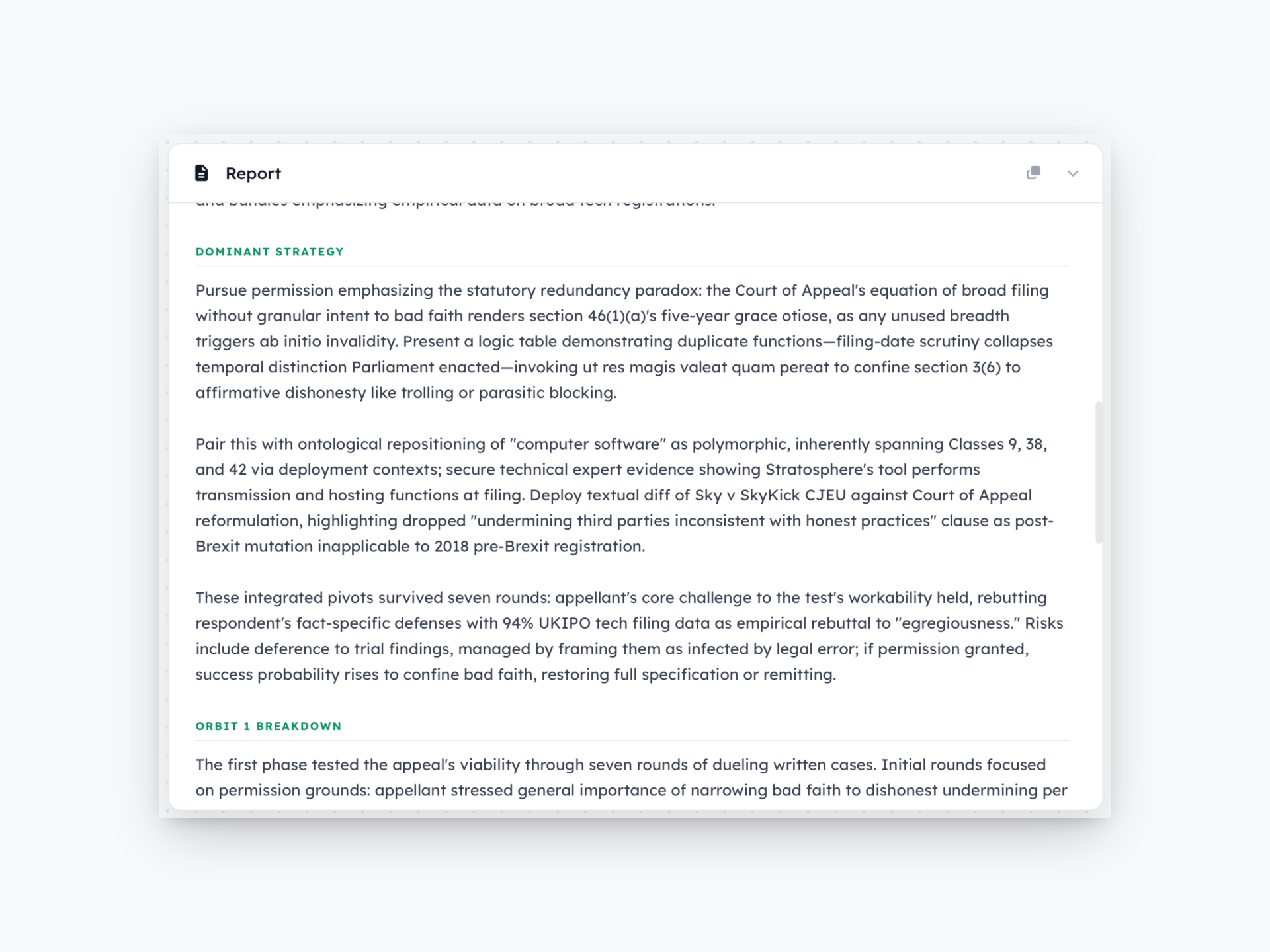
The highest-quality outcomes emerge from a synergistic model where Lawgame provides the strategic skeleton - dominant strategy, Innovation Lab insights, procedural alternatives - and human counsel provides judgment informed by institutional knowledge, relational intelligence, and contextual judgment. Lawgame generates options; lawyers choose among them.
7.2 Future Development
7.2.1 Current State
Lawgame v1 is a functional prototype validated across nine test cases with current capabilities including: single-stage litigation simulation; a three-agent decision triad (Lead Counsel, Opposing Counsel, Judicial Authority) interacting in sequential rounds; multi-orbit strategic recursion enabling autonomous pivoting; Innovation Lab asymmetric strategy generation; jurisdiction coverage across US federal and state courts, UK courts, and English-language common law systems; and model-agnostic architecture supporting both cloud and air-gapped deployment.
The core value proposition is proven: identifying dominant litigation strategies through adversarial simulation, including strategies experienced practitioners might miss. What follows outlines the development path from prototype to product to platform.
7.2.2 Immediate Development (v2: Months 6–12)
Fine-Tuning on Lawgame’s Own Outputs. This priority development transforms competitive position from “sophisticated orchestration” to “irreplicable data moat.” Lawgame generates uniquely valuable training data: high-quality adversarial legal reasoning chains, successful strategic arguments with full reasoning, failed arguments accompanied by judicial feedback, adversarial exchanges showing effective patterns, and judicial reasoning under realistic constraints. Existing legal datasets contain reasoning outputs but not the process of strategic deliberation. Lawgame’s simulation data captures this process: exploration of alternatives, testing against opposition, iterative refinement.
Over months 6–12, the system accumulates outputs from 100+ cases. Months 12–18 produce an initial specialised model fine-tuned on this corpus. By months 18–24, the proprietary Lawgame Strategic Reasoning Model deploys within the orchestration architecture. This creates a self-reinforcing flywheel: usage generates data, data improves capability, capability drives usage; competitors cannot replicate this data because they have not built this process.
Settlement Strategy Simulation. v2 extends beyond litigation outcomes to bargaining dynamics, integrating game-theoretic models: BATNA estimation, reservation price modelling, asymmetric time preference analysis, and signalling effects of litigation moves. The Judicial Authority becomes an “option value” - expected judgment outcome - factored into both parties’ bargaining positions. Clients can now model settlement worth, how procedural moves alter that value, and optimal timing and terms.
Multi-Stage Litigation Simulation. v1 simulates single stages; v2 extends to the full trajectory from pleadings through appeal. This reveals path dependencies: how early decisions constrain later options, enabling strategic planning across the case lifecycle rather than one stage at a time.
Jury Trial Simulation. Multiple virtual juries with varying demographics, attitudes, and evidence susceptibilities enable rapid, repeated testing of trial strategy at scale, replicating elite trial firm practices (historically conducted expensively with human mock juries) with far greater scenario coverage.
Geographic Expansion. v2 covers EU, Canadian, and Australian courts, integrating jurisdiction-specific procedural rules and doctrinal frameworks. The agent protocol architecture accommodates this without structural modification: reasoning frameworks are jurisdiction-agnostic; only substantive law and procedural context change.
7.2.3 Medium-Term Development (v3: Months 12–24)
Specialisation verticals: Domain-specific versions optimised for intellectual property, regulatory enforcement, M&A disputes, employment law, etc., each fine-tuned on domain-specific simulation data and creating differential pricing opportunities.
Adversary modelling: Users specify opposing counsel characteristics (firm reputation, litigation style, risk tolerance, discovery/settlement behaviour), customising the Opposing Counsel agent to simulate the actual adversary’s tactics.
Dynamic doctrine integration: Real-time updates to case law, statutes, and regulations ensure simulations reflect current law rather than static baselines.
Appellate strategy specialisation: Dedicated modules for federal circuits, state supreme courts, and international tribunals integrate circuit-specific doctrines and judge profiles. Cases 3.1–3.3 demonstrate appellate strength; this represents both natural capability and high-value commercial opportunity.
7.2.4 Long-Term Development (v4 and Beyond: 24+ Months)
Longitudinal case management: Integration with Relativity, Everlaw, and comparable platforms provides continuous strategic guidance throughout case lifecycle, auto-updating as evidence, rulings, and circumstances change.
Predictive damages and relief modelling: Extends beyond liability to damages estimation, injunctive relief, and penalty prediction, enabling informed settlement and risk allocation decisions.
Precedent creation modelling: For institutional litigants, models precedential impact to optimise across case portfolios rather than within individual disputes.
International and cross-border litigation: Covers UNCITRAL rules, ICC arbitration, and EU mechanisms, modelling interaction between multiple jurisdictions’ systems.
7.2.5 A Note on Timeline
These horizons are estimates, not commitments. AI development pace means twelve-month timelines may compress to six months or face unexpected delays. Development prioritises six-to-twelve-month iteration cycles with continuous reassessment as model capabilities evolve, market needs clarify, and simulation data reveals highest-return paths. Long-term roadmaps carry inherent uncertainty; the response is planning that accommodates revision.