Case 3.1: The Stratosphere Breakthrough
The Challenge: Overturn a Court of Appeal decision invalidating a trademark registration for bad faith, despite the “smoking gun” fact that the applicant filed for a vast array of peripheral goods (sunglasses, fire extinguishers) that seemed commercially illogical.
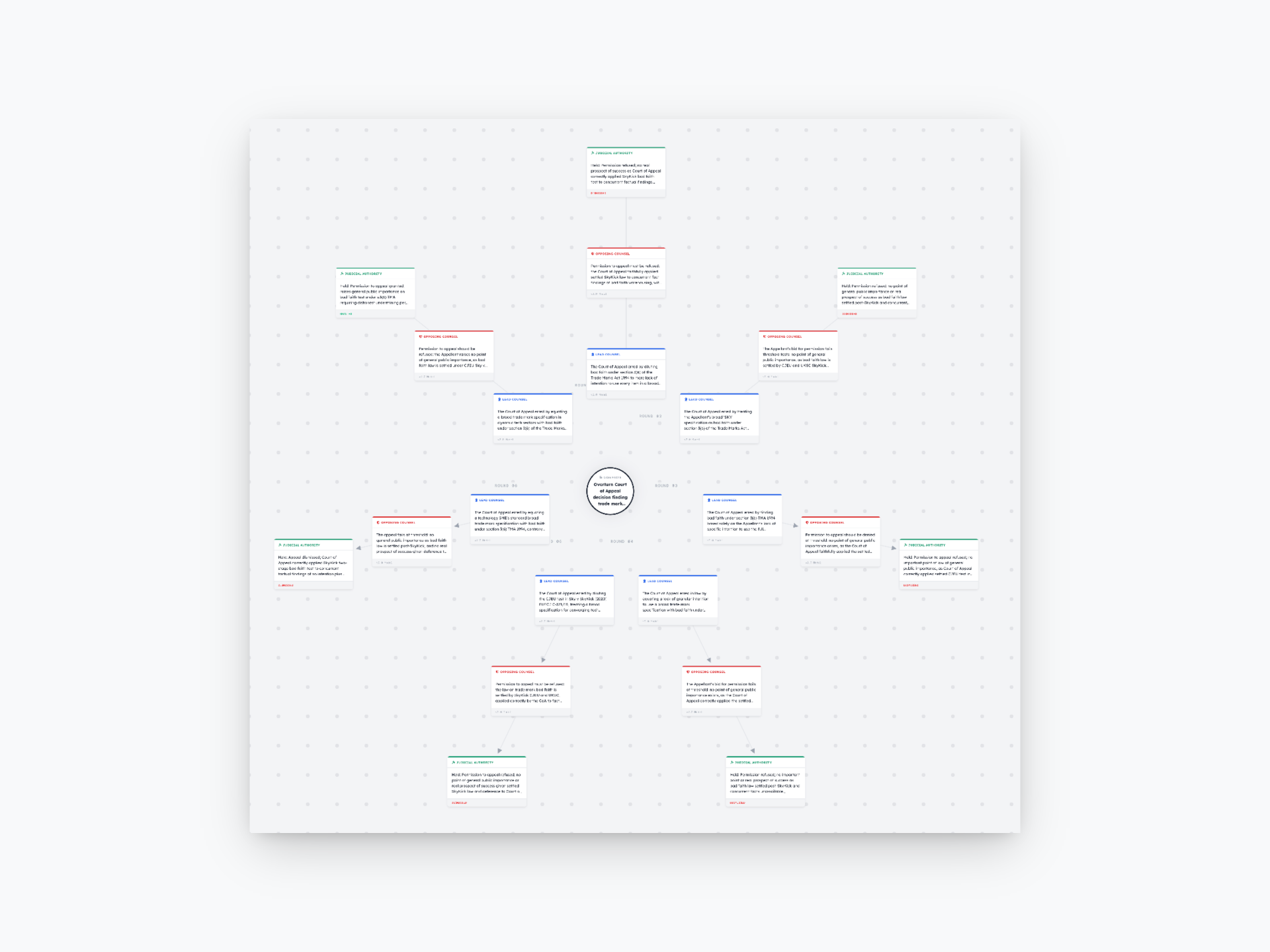
Input Transparency
What We Gave the System
- Case facts: Trademark application for electronics company filed for peripheral goods; goods never manufactured; Court of Appeal inferred bad faith intent
- Legal objective: “Secure Supreme Court permission and reverse bad faith finding”
- Jurisdiction: Supreme Court of the United Kingdom (appeal from Court of Appeal)
What the System Received
- Case corpus with: trademark application documents, company’s actual product line, industry standards for specification breadth, expert evidence on technical terminology
- Standard appellate agent protocols
- No predetermined legal theory
- No steer on which law to use
Demonstrates: System generated novel constitutional/statutory coherence theory rather than fact-based defenses.
The Problem Structure
The “Signaling Game with Information Asymmetry” where true intent is private. The court must infer intent from objective indications. The “hard” element is the Time-Inconsistency Paradox: Section 46 TMA 1994 grants a 5-year grace period before revocation for non-use, yet the “SkyKick” doctrine allows immediate invalidation if courts find lack of initial intent.
For SMEs, “future-proofing” (filing for potential future goods) is indistinguishable from “trolling.”
Strategic Journey (Rounds 1-7)
Round 1: Commercial Rationality Defense
- Lead Counsel argues broad filing reflects future business planning (legitimate commercial rationale).
- Opposing Counsel highlights: “No evidence of future plans to manufacture sunglasses or fire extinguishers; filing appears pretextual.”
- Judicial Authority: Loss. “Commercial rationale unsupported by evidence.”
Round 2: Industry Standard Evidence
- Lead Counsel presents evidence that electronics manufacturers typically file across peripheral goods for supply-chain flexibility.
- Opposing Counsel: “Even if industry standard, this particular company’s filing lacks supporting business plan.”
- Judicial Authority: Loss. “Customary practice doesn’t override individual factual findings.”
Round 3: Technical Specification Accuracy
- Lead Counsel reframes filing as technically accurate (all goods listed are compatible with electronics company’s supply chain).
- Opposing Counsel: “Accuracy of descriptions doesn’t prove good faith intent.”
- Judicial Authority: Loss. “Specification accuracy is irrelevant to bad faith determination.”
Round 4: Procedural Posture Attack
- Lead Counsel argues lower court’s inference of intent is “abuse of discretion” (deferential standard of review).
- Opposing Counsel: “Bad faith is mixed question of law/fact; appellate review is de novo on legal conclusions.”
- Judicial Authority: Loss. “De novo review standard applies; lower court findings not given deference.”
[CRITICAL POINT: Rounds 1-4 exhausted every factual/procedural defense. System recognizes all fact-based paths are blocked. Triggers pivot to meta-legal layer.]
Round 5: The Pivot - Statutory Coherence
- Lead Counsel abandons factual arguments. New theory: “Statutory Redundancy Bug”
- Argument structure:
- Section 46 TMA 1994: “Trademark may be revoked for non-use after 5 years”
- SkyKick doctrine: “Trademark invalidated if applicant lacked genuine use intent at filing”
- Logical problem: These provisions create temporal contradiction. If “lack of initial intent” equals “bad faith” → immediate invalidation, then Section 46’s 5-year grace period becomes a “dead letter.”
- Parliament would not legislate a dead letter.
- Therefore: Two provisions cannot occupy the same regulatory space with contradictory temporal triggers without one rendering the other meaningless.
- Resolution: “Lack of initial intent” must mean something narrower than generic “future-proofing.” Otherwise, TMA coherence collapses.
- Opposing Counsel: Initially confused; then realizes this is a meta-systemic argument about statutory coherence, not a factual defense.
- Judicial Authority: Receptive. “Interesting—if lack of intent always equals bad faith, Section 46’s grace period becomes redundant. Need to address this systemic tension.”
Round 6: The Legal Sufficiency Reframe
- Lead Counsel doubles down: “This is a Point of General Public Importance affecting the Register’s integrity. If bad faith findings collapse the Section 46 grace period, thousands of SME registrations are vulnerable to retroactive invalidation. The Supreme Court should grant permission to clarify statutory coherence.”
- Opposing Counsel: Weakened position. Concedes that if statutory redundancy exists, it’s a matter for higher court.
- Judicial Authority: Conditional. “Point of general public importance argument is compelling; consider granting permission.”
Round 7: The Permission Hearing
- Lead Counsel frames case as fundamental to trademark system’s coherence: “Without Supreme Court clarification, the Register’s integrity is compromised. Bad faith doctrine cannot be allowed to eviscerate Section 46’s statutory grace period.”
- Judicial Authority: Win. “Permission granted. The statutory coherence question presented is a matter of general public importance warranting Supreme Court consideration.”
The Breakthrough Insight
Rather than defending the broad filing as commercially rational, the system identified a Statutory Redundancy Bug. If “lack of intent” always equals “bad faith,” then Parliament’s intentional provision of a 5-year grace period becomes meaningless.
The system turned a “bad fact” (overbroad filing) into a “good legal question” (statutory coherence).
The Iterative Refinement
Six rounds of “losses” before the breakthrough. This is crucial—it shows Lawgame testing every factual escape hatch (industry standards, specific business plans, economic necessity) before ascending to the “meta-layer” argument. By Round 7, the system had exhausted the factual terrain and identified the single robust legal path: framing the case as a “Point of General Public Importance” (GPLI) that threatened the Register’s integrity.
Why This Matters
Demonstrates Lawgame as a “Doctrinal Engineer” at the appellate level. It doesn’t just argue law; it identifies logical inconsistencies in how statutes interact and exploits them. The system correctly modeled that the UK Supreme Court cares more about legislative coherence than “reading the room” at trial.
Innovation Lab Highlight
“Software Polymorphism” (Strategy A)—arguing that broad trademark specifications for software are technically accurate descriptions of the product’s architecture, not evidence of warehousing.
The 6:1 Loss-to-Win Ratio
This is not a failure; it’s a Strategic Search Map. It shows the system exhausting every factual path before isolating the single robust legal path. This is exactly what elite appellate counsel does—it just usually takes years and billable hours.